
Employer Branding

Employer Branding
What is Employer branding?
07 FEBRUARY 2025
Employer branding refers to how a company is perceived as a workplace and employer by its current, past, and potential future employees. Just as a company has its consumer brand, it also possesses its employer brand – a reputation as an employer.
What does employer branding mean for your company?
Establishing a positive and transparent employer brand can help your company stand out, enhance employee engagement, and create a common foundation to achieve your goals.
But – engaging in developing your employer branding and company culture isn’t just about ensuring the well-being of the employees, although that’s a positive side effect. It’s about empowering your employees and organization to work towards shared strategic goals and attracting new candidates who share your values and are eager to contribute to the journey.
The role of social media in employer branding
As digital media entered the job search landscape, the expectations and behaviour of gathering information have undergone a significant transformation – mainly due to the influence of social media. Nowadays, we’re accustomed to accessing information about nearly anything at any time and exactly when we want it.
According to LinkedIn’s survey “The ultimate list of employer brand statistics,” the lack of information and limited insight into company cultures is what truly stands as the most significant obstacle candidates face in their job search.
When potential employees lack certainty about your company’s stance as an employer, a substantial risk emerges – the chance to engage with these candidates may never materialize. Consequently, fewer talented individuals may consider your company as a potential employer.
Would you purchase a house without seeing its interior?
The real estate sector has long recognized this principle. Prospective homebuyers aim to gather as much information as possible about a house before purchasing. The realtor’s strategy of sharing photos, videos, and open house invitations (nowadays, often digitally), even though only a minority of these viewers will eventually purchase, is grounded in this concept. Only one buyer will win.
In the context of job hunting today, the same anticipations arise. We expect to access comprehensive information about the job and the company we’re considering investing our valuable time and effort into. Honestly, would you buy a house without seeing its interior? Of course, you wouldn’t.
In-depth insight: Crafting an appealing employer proposition for candidates.
An essential part of developing an employer brand involves identifying and communicating the company’s EVP (Employer Value Proposition). Access our guide and learn how to assemble your company’s unique offerings for current and potential future employees.
Four reasons to invest in your employer brand
Engaging in your employer brand is a valuable investment for all companies, regardless of size, aiming to compete in today’s job market and establish a solid and successful business. Below, we’ve listed more benefits of a strong employer brand.
1. Attracting top-tier talent
A strong employer brand can help your company stand out in a competitive job market and attract talented candidates who share your values and goals.
2. Retaining existing staff
A positive employer brand that fosters a sense of community can also help you retain your employees by making them feel valued, engaged, and motivated to stay.
3. Enhancing employee motivation
Investing in your employer brand can also enhance employee well-being and engagement, improving performance and increasing productivity.
4. Creating a positive reputation
Furthermore, it can improve your company’s overall reputation and image, making it more appealing to potential employees and customers, partners, and investors.
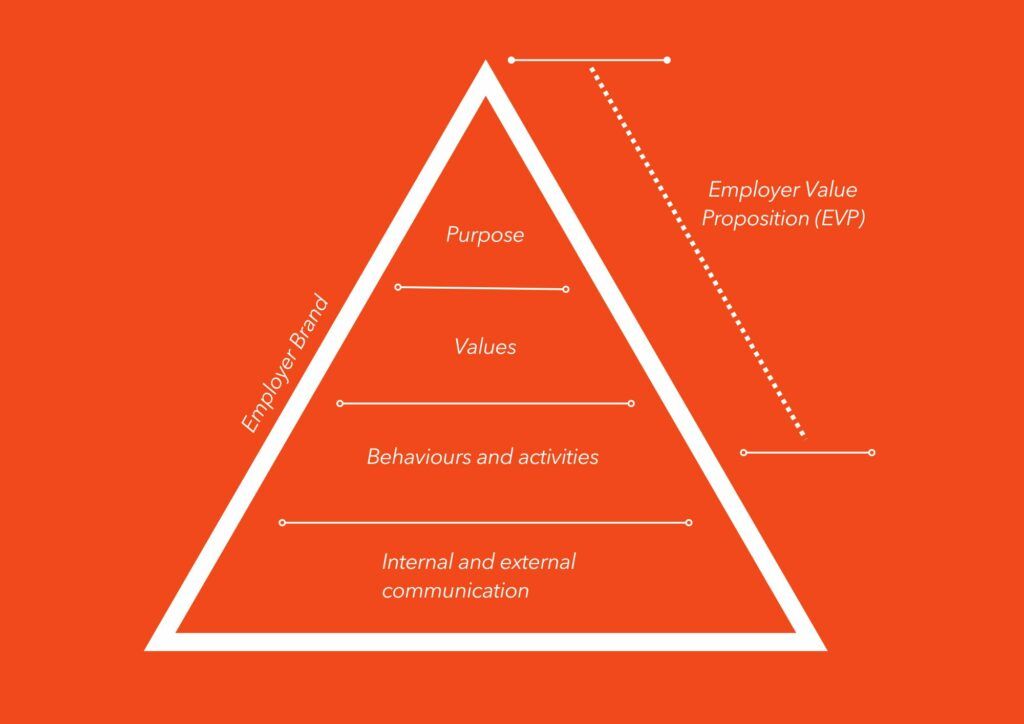
Oddmodel of employer brand
At Oddwork, we work with a model for employer branding and attractive company cultures called the Oddmodel of Employer Brand. This model consists of four layers and is developed based on the latest trends and insights from approximately five thousand interviews we conduct annually with talents across Sweden.
Here’s an overview of the different components within the model:
- At the top of the pyramid, you’ll find the organization’s Purpose – your company’s overarching goal or guiding principle, addressing questions such as: Why does our company exist? How do we contribute to a better world?
- On the next level lies the Values of the organization – the fundamental values underpinning your company’s corporate culture.
- Next, you’ll find corporate Behaviors, Activities, and Associations aimed at bringing a corporate culture to life, a culture that truly manifests when we enact and embody our core values in day-to-day interactions.
- At the bottom of the pyramid, you’ll find Internal and External Communication– how your company conveys its employer brand and corporate culture to the candidate segments, fostering recognition as an attractive employer among the target audiences you want to attract.
If you want to learn more about how the model works and manifests in real-world scenarios, please don’t hesitate to contact us!
Employer branding strategy in five steps
At Oddwork we work with a five-step model. It turns employer branding into a structured, long-term effort rather than a series of one-off campaigns.
1. Understand
Build a shared understanding of what employer branding is and why it matters for your organisation. Leadership, HR and communications need the same starting point. A good first step is a workshop or an employer branding training session.
2. Analyse
Find out how you are perceived today. Interview employees, analyse your candidate target groups and benchmark yourself against the employers you compete with for talent. Also check what AI services like ChatGPT and Gemini say about you as an employer. An EB Audit gives you a data-driven baseline.
3. Internal employer branding
Define your EVP together with your employees and anchor it with your leaders. An employer brand that does not match everyday reality will not last.
4. External employer branding
Translate the EVP into a communication concept and activate it where candidates are: career site, job ads, social media, employee video and events.
5. Measure and evaluate
Follow up with clear KPIs such as awareness, number of qualified applicants, candidate experience and employee turnover. Read more in our guide to employer branding KPIs.
Employer branding examples
What it can look like in practice:
- SEB Greenhouse: Oddwork as national employer branding partner for SEB’s offer to growth companies.
- If Insurance: A Nordic employer branding partnership to raise awareness of If as an employer.
- Sendify: From EVP to activation strategy in a fast-growing tech company.
Find more examples among our success stories.
Frequently asked questions about employer branding
What is the difference between employer brand and employer branding?
Your employer brand is how you are perceived as an employer. Employer branding is the work of shaping and communicating that perception.
Who owns employer branding in an organisation?
Usually HR or Talent Acquisition, working closely with communications and marketing. Support from leadership is essential, since an employer brand is built on how the organisation actually works.
How long does it take to build an employer brand?
Developing an EVP often takes four to five months. Changing how the market perceives you takes longer and requires consistent communication, often one to three years.
How much does employer branding cost?
It depends on the scope. An analysis or workshop is a smaller investment, while an EVP, a communication platform and ongoing campaigns require more. See our overview of employer branding agencies and platforms in Sweden.
Do smaller companies need employer branding?
Yes. Smaller companies often compete for the same talent as large ones, but with lower awareness. A clear EVP and honest employee stories make a big difference even on a small budget.
Summary
Employer branding is about attracting, engaging and retaining the right talent by building a strong employer brand. To succeed you need to:
- Understand where you stand and how you are perceived, by candidates and by AI services
- Define and anchor your EVP
- Activate it on social media, on your career site and throughout the candidate journey
- Build a company culture that delivers on your promise
- Measure the impact with clear KPIs
Want help getting started? See how Oddwork works with employer branding or contact us.